Keyboard changes of Marcus Miller’s “The King is Gone (for Miles)”

In his 1993 album The Sun Don’t Lie, Marcus Miller pays homage to the late Miles Davis with a poignant musical tribute. The track The King is Gone opens with Miller’s masterful bass clarinet playing a melancholic melody, supported by stunning keyboard chords.

You can find the chords transcribed below, and a PDF score is also available.

Marcus Miller is renowned for his electric bass playing and impressive slapping solos. The King is Gone showcases his mastery of intricate harmonic colors. Although the piece is primarily in the key of B minor (and evokes the darkness/sadness/nostalgia that a minor key is typically associated with), his arrangement features prominent use of “unstable” sequences of #9 chords and fourth voicings, and key changes I can’t match with simple and regular theory.

  • The first three bars of the melody strikingly deviate from B minor. Are they harmonic tension preceding release to the main key? Do these bars hide a semitone resolution to B minor (if so, up or down?) Or did Miller install there a short harmonic modulation from another remote key to B minor? The chromatic descending patterns of vertiginous #9 chords on the keyboard don’t help figure this out.
  • The part at bar 17 seems to switch to C minor for two bars, then jump to A minor. The turnaround loop on F and E7#9 (bars 20, 21, and 22) is a natural dominant sequence of chords in A minor. Still, the out-of-key opening theme takes over at bar 23, and harmony smoothly returns to B minor.

Juggling chords with such ease definitely requires a musician of great sensitivity.

Notes

  • In the video above, I play the keyboard along with the official recording by Marcus Miller. The original melody is slightly audible in the background while the chords I play are overlaid on top of it. In order to highlight my keyboard playing, I have reduced the volume and applied filtering to Marcus Miller’s keyboard part as much as possible.
  • As explained, the reference recording is released in The Sun Don’t Lie. Still, listening to other versions can be of interest:
    • A stunning live version was recorded in Vienne, France in 1994 (a concert I attended !). Genius Bernard Wright plays a hypnotic keyboard introduction. Choruses are outstanding. The final theme is particularly moving.
    • Another live recording of 1994 is released on “Dreyfus Night in Paris” where Marcus Miller is jamming with the great Michel Petrucciani. Petrucciani is playing the chords on the piano, but they are only approximating the original record’s harmony.
    • Julian Joseph directs an interesting big band arrangement (digitized footage from a worn VHS tape!).

The intriguing symmetry in Purple Rain’s strings outro

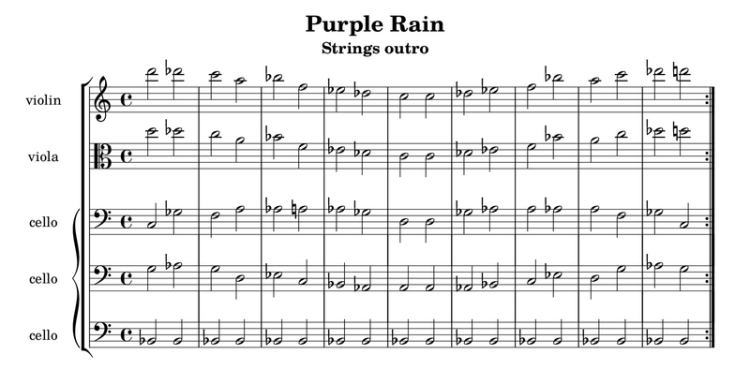
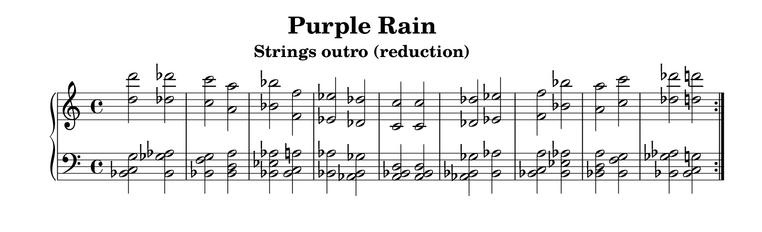
Some clever chords are heard at the end of Purple Rain when the string instruments play their magical outro. Sadly, no official score is available to examine them. Last summer I resolved to transcribe this fascinating part.

The series of chords is symmetric! Indeed, individual instruments play symmetric phrases: Each voice consists in a series of nine notes, played forwards then… “rewound”. Have a look to the topmost one.

Fancy! Musical palindromes aren’t just J.S. Bach’s territory! Here’s a video of my finished transcription.

Full and reduced scores in PDF

If “Purple Rain” is in your setlist, please don’t pass up the opportunity to play this ingenious part!

Keyboardists can use the reduced score.

A string section can pick the full score.

Keyboard how-to

Self-taught keyboardists, maybe this video can help you?

Technical notes

Details worth mentioning.

  • The lead voice is doubled in octaves. String instruments blend well enough this can be unnoticed, but it is clear when they play in a low range.
  • The keyboard playing in the background shouldn’t be mistaken with a string instrument. It plays a low Bb pedal throughout the outro. It also plays a high F during the second bar.
  • In the instrumental version, before the outro starts, a cellist accidentally hits a string. It plays a low Bb. Considering Bb is played as a pedal tone, I concluded a cello plays it throughout in unison with the keyboard.
  • Individual instruments can be tracked thanks to their different panning in the mix. That’s how one comes across the first and second cello voices crossing in the second bar.
  • A perplexing low Gb is heard in the eighth chord. It appears out of nowhere, it is oddly loud. I’d prefer knowing it is an interference of some sort or a combination tone (why not?). My attempts to include it in the transcription didn’t sound right. I left it out.

References

  • Of course one should listen to the primary recording as a reference. But the strings outro is also heard in this lovely instrumental version.
  • The outro is cut out from live performances. Too bad. At best Prince would play a sample of the original record.
  • I carefully listened to Cory Henry’s beautiful cover where strings play the outro. Fewer lines are heard. Chords are therefore incomplete.
    • The lead voice is the same, except theirs is embellished with an interesting octave jump in the second bar.
    • A Bb pedal is played throughout. That’s important.
    • Cellos mostly play the second cello voice of my transcription, but their last two notes are picked from the first cello voice. It is therefore not symmetric!
  • A couple of keyboardists have published videos of their own transcription.
    • Check Mychael Pollard’s arrangement. It sounds mostly right, but I wasn’t convinced by the presence of an A in the first chord. The last chord misses the C.
    • Milo Fultz published a video too. I believe he’s missing some notes (the C in the first chord, the D in the 9th one). Other than that, while both our transcriptions identified the same notes, they significantly differ in octave placement.
    • I listened to Adam Kupper’s arrangement. The G in the second chord feels really wrong too me, as well as the C in the third one.
  • Luke Stanley contributed an interesting guitar arrangement. Adapting the string outro to a guitar obviously requires workarounds. Regardless, his voicings are not weird enough to be accurate; the second chord is definitely not just a Bbm7! That said, I liked his cover. He sounds terrific!